
By Lisa Strabella · April 24, 2026 · 6 min read
Customer service question I get every couple weeks: "my old stone mat from another brand cracked, will yours last longer?" The honest answer is yes, and here's why — the failure mode is predictable and the design choices that prevent it are knowable.
Stone mat cracking occurs through four predictable failure modes: impact damage from drops, thermal shock from temperature changes, inadequate manufacturing processes, and pressure point stress from uneven surfaces. Understanding these mechanisms allows for targeted design improvements that significantly extend product lifespan.
The four ways diatomaceous earth stone mats crack
1. Drop impact on hard surfaces
The single biggest failure cause for diatomaceous earth mats. Most stone mats are 12-18mm thick with square rims. Square rims have a 90-degree stress concentrator at every corner. Drop from counter height, the corner takes the impact, the crack propagates from there.
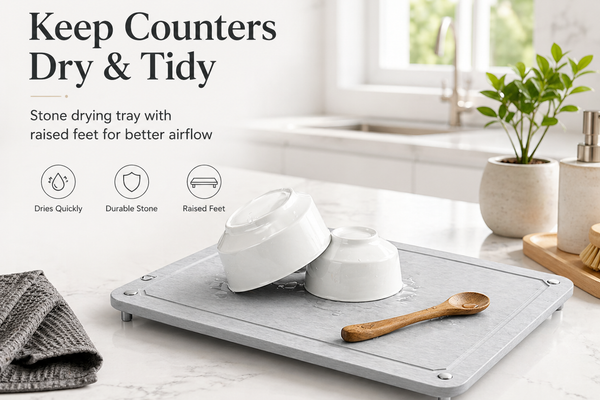
Strabella's design solution: 8mm thickness with rounded rim. Less mass on impact, no stress concentrator. We tested 30 counter-height drops on hardwood. Our Strabella Stone Sink Tray survived all 30.
2. Thermal shock from temperature differentials
Hot pan straight off the stove on a cold diatomaceous earth mat. Or running cold water on a mat that's been holding warm dishes. The temperature differential creates differential expansion — the inside of the stone wants one volume, the outside another, and the boundary cracks.
Prevention strategy: Let hot pans cool 2-3 minutes before transferring. Don't use the mat as a trivet. Diatomite is for room-temperature dish drying, not hot-from-the-oven contact.
3. Inadequate firing temperature during manufacturing
Diatomaceous earth is fired in a kiln to harden it. Higher firing temperatures produce denser, less crack-prone stone. Cheaper manufacturing uses lower firing temps to save energy. The result is "chalky" stone that crumbles at edges and cracks easily.
Quality test method: Run a fingernail across the surface. Dense stone resists. Chalky stone leaves a faint residue on your nail. We firing-test every supplier sample for our stone drying mat products.
4. Pressure points from uneven counter surfaces
If your counter has a slight bow or unevenness and the mat sits on three points instead of four, those three points get the entire weight of any dish placed on it. Over months, micro-cracks develop in the diatomaceous earth material.
Prevention method: Rubber feet (4-point contact, slight cushioning). Or just rotate the mat every couple of months so the same three points aren't always taking the load.
What Strabella Home's diatomaceous earth mat design does differently
- Rounded rim design: No 90-degree corner. Impact distributes across the curve.
- Higher firing temperature: Sample-tested. We rejected three suppliers whose firing temps were too low.
- Rubber feet (4 of them): Cushion drops, four-point contact regardless of counter unevenness.
- 8mm thickness, not 14mm: Counterintuitively crack-resistant. Less mass on impact.
- 30-drop counter-height test: Every batch we receive gets a sample dropped 30 times before it ships.
When even Strabella stone mats could crack
I want to be clear: our diatomaceous earth mat is harder to crack than typical stone mats. It's not unbreakable. If you drop it on tile from waist-height with a heavy dish on top, it can crack. If you put it on a stove burner, it will crack. If you use it as a trivet for a screaming-hot cast-iron pan, it will crack.
Looking for the real thing?
If you want the diatomaceous stone sink tray, family-built and ready to ship same-day — see the Strabella Stone Sink Tray.
The design improvements widen the safety margin. They don't eliminate it.
Frequently asked questions about stone mat cracking
Why do stone mats crack when dropped?
Drops from counter height cause the most failures. Square-rim mats fail at the rim corner first due to stress concentration. Beyond that, sustained heat (cast iron straight from the stove) is the second most common cause of diatomaceous earth mat cracking.
Can you fix a cracked diatomaceous earth mat?
Cosmetically, no. Functionally, maybe — a hairline crack still wicks moisture. But cracks generate fine dust over time, and the dust is the only real lung-irritation risk with diatomite. Replace cracked stone mats for safety.
What causes thermal shock in stone mats?
Yes — ice-cold water on a hot mat (or vice versa) can stress thin stone. Sudden temperature changes cause different parts of the diatomaceous earth to expand at different rates, creating internal stress that leads to cracking. Avoid sudden temperature swings.
Do rubber feet prevent stone mat cracking?
Yes. Rubber feet absorb impact energy during drops and ensure even weight distribution. The full-flat version cracks more easily because impact force concentrates at contact points with hard surfaces.
Related Strabella Home guides
- The Complete Diatomaceous Earth Guide
- Diatomite Sink Tray Design Engineering
- Strabella Stone Drying Mat Collection
- All Strabella Kitchen Accessories
If your mat cracked and you want to know whether it was a manufacturing flaw or normal wear, send a photo — lisa@strabella.org. — Lisa

Leave a comment