
Ippodo Tea has been selling tea in Kyoto since 1717, and Ummon-no-mukashi — usually just called Ummon — is the blend people land on when they start taking matcha seriously. It is the priciest of Ippodo's classic "-no-mukashi" blends and the one the company points at when it wants to show what its matcha can do.
Quick answer
Ummon costs $82 for the 40 g can on Ippodo's own US store, which works out to about $2.05 a gram. Buy it if you want koicha (thick tea) from a Kyoto house with three centuries behind it. If you mainly drink daily usucha and that per-gram number stings, Strabella Asanagi is a 54 g single-origin first-harvest Uji tin at $49 — about $0.91 a gram — that ships from California.
Ippodo Ummon price in 2026
| Format | Where | Price | Per gram |
|---|---|---|---|
| 40 g can | Ippodo US store | $82 | ≈ $2.05 |
| 40 g zip bag | Ippodo US store | $81 | ≈ $2.02 |
| 20 g box | Ippodo global store (tax excluded) | ¥4,000 | ≈ ¥200 |
| 20 g box | Ippodo Japan store (tax included) | ¥4,320 | ≈ ¥216 |
Two things worth knowing before you compare these numbers to anything else:
- The US store does not sell a 20 g Ummon at all. If you are in the States, your choice is the 40 g can or the 40 g zip bag. The bag is a dollar cheaper and holds the same tea; the can is simply a better container once it is open.
- The two yen prices are the same box. The global store lists tax-excluded, the Japanese domestic store lists tax-included. It is not two different products.
Where Ummon sits in Ippodo's own range
Ippodo's 20 g matcha boxes run, from the top: Kanza ¥10,000, Kuon ¥6,000, Ummon ¥4,000, Shoin ¥3,000, Sayaka ¥2,200, Kan-no-shiro ¥1,600, Ikuyo ¥1,200, Wakaki-shiro ¥800, Hatsu ¥600.
So Ummon is the third-priciest 20 g box and third by price per gram, behind Kanza and Kuon. It is not the most expensive matcha Ippodo sells — but it is the priciest of the classic "-no-mukashi" blends, which is why it gets treated as the house benchmark.
What Ummon is actually for
Ippodo rates Ummon for both koicha and usucha, and publishes separate specs for each: usucha at 2 g to 60 ml of 80 °C water, whisked about 15 seconds in an "M" motion; koicha at 4 g to 30 ml at the same temperature.
The brand's own description calls it "one of the richest, most full-forced matcha blends in our selection," with "a powerful umami, deep emerald green color, and sweet aroma." Ippodo's president recommends preparing it "a little on the strong side so that you can feel its full impact."
That is the honest case for the price: this is a thick-tea matcha that also works thin. If you are never going to knead a bowl of koicha, you are paying for a capability you will not use.
One thing Ippodo does not claim
Ummon is frequently described online as an Uji matcha. Ippodo does not say that on the product page. The only origin statement the company makes for this blend is that it is blended and packaged in Japan by Ippodo Tea, Kyoto. No cultivar, no tencha farm, no harvest year is published. If a shop tells you Ummon is single-estate Uji, they are adding something the brand does not.
Buying it in the United States
Ippodo runs its own US storefront at ippodotea.com, and orders ship from a US warehouse rather than from Kyoto. Shipping is free over $39, with gift cards and utensils excluded from that threshold. For US buyers this is the route that makes sense — and since the 40 g formats are sold only by the US store, there is no reason to order Ummon from Japan.
The alternatives, for completeness:
- Ippodo's global store ships from the Kyoto main store by DHL, EMS or air packet. Orders leave in about five business days and take anywhere from seven days to five weeks to arrive depending on method and destination. Duties are yours. The global store also caps matcha purchases at ten items per order.
- Amazon. Three Ummon listings exist. On 29 August 2026 all three were out of stock with no active price, so there was nothing to compare.
Ummon vs the alternatives, per gram
| Ippodo Ummon | Marukyu Koyamaen Kinrin | Strabella Asanagi | |
|---|---|---|---|
| Best for | Koicha + usucha | Koicha + usucha | Daily usucha |
| Origin as stated by the brand | Blended and packaged in Kyoto | Uji, Japan | Uji, Japan (single origin, first harvest) |
| Tin size | 40 g | 40 g | 54 g |
| US price | $82 | about $75* | $49 |
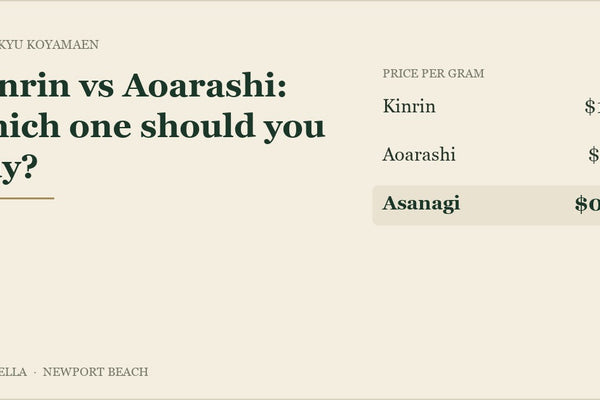
| Approx. price per gram | $2.05 | ≈ $1.88 | $0.91 |
| US availability | In stock, US warehouse | Variable | In stock |
| Ships from | US warehouse | Depends on retailer | California |
*US specialty-retailer listing price observed on 29 August 2026, not a brand-set price.
- Best for koicha from a Kyoto house: Ippodo Ummon
- Best Uji koicha alternative: Marukyu Koyamaen Kinrin
- Best value for a larger Uji daily-drinking tin shipped from the US: Strabella Asanagi
Is Ummon worth $82?
We sell teaware and our own single-origin matcha, so read this as a seller's opinion, not a neutral verdict.
If you want koicha, yes — and there is no cheap route to koicha-grade matcha from a house of this standing. Three hundred years of blending consistency is a real product attribute, and Ippodo's US warehouse means you get it without customs.
If you drink one bowl of usucha in the morning, the maths gets harder. At $2.05 a gram, a daily 2 g bowl is about $1.50 a day in matcha alone, and the 40 g can is roughly twenty days of drinking.
Our Asanagi is a single-origin first-harvest Uji tin, 54 g for $49 — about $0.91 a gram, or roughly 27 bowls. That is less than half Ummon's per-gram price. We are not going to tell you it beats Ummon in a side-by-side koicha tasting, because we have not run that test and neither has anyone else who is being straight with you.
What we will say is narrower: for daily usucha, in a larger tin, at under half the per-gram cost, from a single Uji origin and a first harvest — that is the trade we made for ourselves, and it is the tin we drink every morning.
Buy Ummon when you want koicha, or when you want Ippodo specifically. Buy ours when you want Uji matcha in stock and shipping from California within one business day.
Frequently asked questions
How much is Ippodo Ummon 40g?
$82 for the can and $81 for the zip bag on Ippodo's US store, as of 29 August 2026. Both hold the same tea.
Can I buy Ummon in 20g in the US?
No. The 20 g box is sold only through Ippodo's Japan-facing stores. The US store stocks the two 40 g formats.
Is Ummon good for lattes?
It will taste fine, but milk and sugar erase most of what you paid for. Ippodo makes less expensive blends better suited to that.
Is Ummon Ippodo's best matcha?
Not the most expensive — Kanza and Kuon sit above it. Ummon is the top of the classic "-no-mukashi" line and the blend the company positions as its benchmark.
How long does a 40g can last?
About twenty days at one 2 g usucha bowl a day, or ten days if you are making koicha. Keep it airtight, cold and dark, and finish it within four to six weeks of opening.
Sources and method
Last verified: 29 August 2026.
How we checked this. Prices, formats and stock status were read directly from Ippodo's own storefronts on the date above and re-checked against a second source. Tasting descriptions are quoted from Ippodo's published product copy, not from our own tasting — we have not run a comparative tasting of these matchas and nothing here is presented as one. We sell teaware and our own single-origin matcha, which is disclosed in the section where we mention it.
Primary sources:
- Ippodo Tea — Ummon 40 g can, US store: ippodotea.com
- Ippodo Tea — Ummon 40 g zip bag, US store: ippodotea.com
- Ippodo Tea — Ummon 20 g box, global store: global.ippodo-tea.co.jp
- Marukyu Koyamaen — Kinrin, international shop: marukyu-koyamaen.co.jp
Written and edited by the Strabella team, Newport Beach, California. We sell matcha and teaware, including the Asanagi tin referenced above. Corrections: info@strabella.org.
Leave a comment