
An eco friendly dish drying mat is a countertop mat made from materials — such as diatomaceous stone, bamboo-derived fabric, or recycled microfiber — that minimize environmental impact while absorbing water from drying dishes. The best options balance real absorbency with low chemical content, machine-washable or wipe-clean maintenance, and a lifespan long enough to offset their production footprint. If you're deciding between material types, the short answer is: diatomaceous stone mats dry the fastest and require no laundering, while fabric mats (bamboo or recycled fiber) are softer, more packable, and typically easier on delicate dishware.
How We Evaluated
The assessments in this guide are based on manufacturer-reported specifications, documented material properties, and aggregated user experience across the product categories covered. We did not conduct independent lab testing or third-party absorbency trials. Where performance figures appear (such as dry times or wash cycle guidance), they reflect typical ranges reported by manufacturers or commonly cited in category research — not controlled measurements. We highlight known trade-offs alongside each material's strengths so you can make the most informed choice for your specific kitchen.
Why the Material of Your Dish Drying Mat Matters
Conventional dish drying mats are often made from virgin polyester microfiber — functional, but not without trade-offs. Synthetic microfiber can shed microplastic particles with each wash cycle, and mats made from it are typically not biodegradable at end of life. Eco-conscious alternatives address this in different ways, depending on the material chosen.
The three most widely available eco-friendly mat categories in 2026 are: natural mineral stone (diatomaceous earth), plant-derived fabric (bamboo or cotton), and mats made from recycled materials. Each has a distinct performance profile, and the right choice depends on your counter space, dish volume, and how much maintenance you want to manage.
| Material | Typical Dry Time | Washable? | Best Surface Feel | End-of-Life | Best For |
|---|---|---|---|---|---|
| Diatomaceous Stone | 30–60 minutes (air dry) | Wipe or light sand; not machine washable | Firm, stone-like | Mineral — does not biodegrade easily, but no plastics | Small loads, fast drying, modern kitchens |
| Bamboo-Derived Fabric | Typically dries flat within a few hours | Yes — machine washable | Soft, cloth-like | More biodegradable than synthetic; processing varies | Families, frequent dishwashing, delicate items |
| Recycled Microfiber | Moderate — typically under 2 hours | Yes — machine washable | Plush, flexible | Recycled plastic content; still sheds microplastics | Budget-conscious buyers prioritizing waste reduction |
| Organic Cotton | Slower — may take several hours | Yes — machine washable | Soft, absorbent | Biodegradable if undyed or naturally dyed | Those avoiding synthetics entirely |
Diatomaceous Stone Mats: Fast-Drying and Low-Maintenance
Diatomaceous earth is a naturally occurring sedimentary mineral made from fossilized algae. In mat form, it's compressed into a rigid slab that absorbs surface moisture almost on contact and releases it through air evaporation — typically within 30 to 60 minutes under normal kitchen conditions, though this varies by room humidity and mat thickness.
The Strabella Home Diatomaceous Stone Drying Mat (15.7×11.8 in) is sized to fit comfortably alongside a single sink basin. It requires no laundering — maintenance involves a quick wipe or occasional light sanding with fine-grit paper if the surface becomes less absorbent over time. It won't mildew, and it doesn't retain odors the way fabric mats can.
The trade-off: diatomaceous stone mats are rigid and breakable. They're not suitable for households that need a mat that folds away or travels. They're also best for smaller dish loads — a single mat won't handle the output of a full dinner party's worth of pots.
For a curated sink-side setup that pairs a stone tray with complementary accessories, Strabella's Sink-Side Reset Set (5-Piece Stone & Wood Kitchen Bundle) is worth considering — it combines the stone tray format with wooden and stoneware pieces designed to work together visually and functionally.
Are diatomaceous earth mats actually eco friendly?
Diatomaceous earth is a naturally mined mineral, which means it involves extraction but contains no plastics or synthetic chemicals. It doesn't biodegrade in the way organic materials do, but it also doesn't contribute microplastic runoff when used or washed. Most buyers in the sustainability space consider it a solid middle-ground option — lower chemical footprint than synthetic mats, longer usable lifespan than fabric mats, but with an extraction impact at the sourcing stage.
Fabric Dish Drying Mats: Soft, Washable, and Versatile
Fabric mats — particularly those made from bamboo-derived viscose, organic cotton, or blended fibers — are the most familiar format. They roll up, fold flat, and can be tossed in the washing machine when they need a refresh. For households doing larger dish loads or washing bulkier items like pots and cutting boards, a generously sized fabric mat provides cushioning that a stone slab cannot.
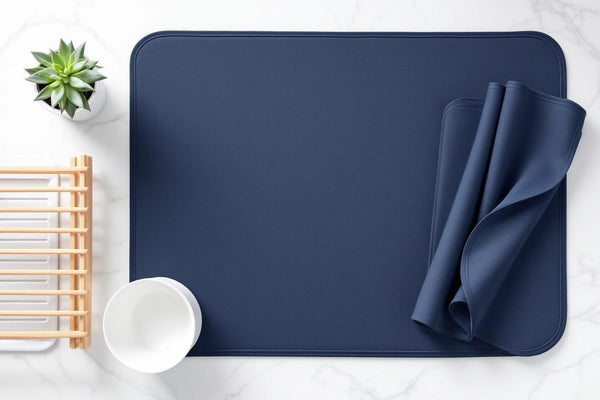
Strabella Home offers fabric mats in multiple colorways. The Navy Dish Drying Mat (Super Absorbent, Non-Slip) and the Black Dish Drying Mat (Super Absorbent, Non-Slip) are both designed with a non-slip backing that keeps the mat in place on wet countertops — a practical feature that's easy to overlook until a mat shifts under a heavy casserole dish.
When evaluating any fabric mat's eco credentials, look for OEKO-TEX certification (which screens for potentially harmful substances in textiles) or GOTS certification for organic cotton content. These third-party standards give you more assurance than marketing language alone. Bamboo fabric is often promoted as inherently sustainable, but the fiber's environmental profile depends significantly on how the bamboo is processed — mechanical versus chemical extraction methods differ considerably in their impact.
How often should a fabric dish drying mat be washed?
A general guideline is every three to five days with regular use, or sooner if the mat develops an odor or stays visibly damp for extended periods. Allowing a fabric mat to sit wet for too long encourages bacterial growth, which undermines both hygiene and the mat's longevity. Machine wash on a gentle cycle and air dry rather than tumble dry when possible — heat can degrade elastic backings over time.
What to Watch for When Buying an Eco Friendly Dish Drying Mat
The term "eco friendly" on product packaging has no regulated standard in the US, so it's worth looking beyond the label. A few things to check before purchasing:
- Backing material: Many fabric mats use a PVC or vinyl non-slip backing, which reduces the overall eco profile of an otherwise natural-fiber mat. Look for TPE (thermoplastic elastomer) or natural rubber alternatives where possible.
- Dye certifications: Synthetic dyes in darker-colored mats may contain potentially harmful chemicals. OEKO-TEX Standard 100 certification indicates the finished product has been tested against a list of restricted substances.
- Wash cycle guidance: A mat that can handle regular machine washing without deteriorating quickly is more sustainable over time than one that needs frequent replacement. Check manufacturer guidance rather than assuming all fabric mats are equally durable.
- Packaging: Some brands offset a sustainable product with excessive single-use plastic packaging. Minimal or recycled packaging is a reasonable secondary consideration.
Is a dish drying mat more eco friendly than a dish drying rack?
It depends on the materials involved. A mat made from natural or recycled materials generally has a lower manufacturing footprint than a metal wire rack, and mats take up less counter space. However, a well-made stainless steel or bamboo drying rack can last considerably longer than most fabric mats — often many years with minimal maintenance. If longevity is your priority, Strabella's Bamboo Dish Drying Rack (2-Tier Collapsible) or the 304 Stainless Steel Dish Rack (Expandable 2-Tier) are worth comparing against a mat. Many households use both: a rack for tall items and a mat alongside it for flat items and overflow.
Best For: Matching the Right Mat to Your Kitchen
Best for Small Kitchens with Limited Counter Space
A diatomaceous stone mat in a compact size — such as the Diatomaceous Stone Sink Tray (Set of 2) — works well when counter real estate is tight. The stone format dries quickly, so the mat doesn't need to sit out all day, and the rigid slab doubles as a neat visual element even when not in active use.
Best for Households That Wash Dishes Multiple Times a Day
A larger fabric mat with strong absorbency and a non-slip backing handles high-frequency use better than stone. Look for mats with a high fabric weight — lighter mats saturate faster and take longer to recover between uses. Hanging the mat to air dry between rounds significantly extends its effective life.
Best for Design-Forward Kitchens
If your kitchen is organized around a deliberate aesthetic — minimal, Japandi, or neutral-toned — material and color matter as much as function. The stone mat format in off-white or gray, paired with wood-handled accessories like those in the Sink-Side Reset Set, keeps the counter looking cohesive rather than utilitarian.
Best for Households Replacing a Dish Rack
If you're transitioning away from a metal drying rack and want a full countertop solution, a large fabric mat paired with a compact rack gives you the best of both formats. A mat handles flat items, glasses, and overflow while a small collapsible bamboo rack manages mugs and upright plates without dominating the counter. This combination is also easier to clear away before cooking than a fixed rack setup.
Best for Coffee and Matcha Stations
A dedicated mat under a coffee or matcha station keeps spills contained without requiring you to wipe down the counter after every cup. The Coffee Bar Mat (Super Absorbent, Non-Slip) is designed specifically for this use — it protects the surface under a pour-over kettle, matcha bowl, or bamboo whisk set without looking out of place in a styled countertop arrangement.
Caring for an Eco Friendly Dish Drying Mat to Maximize Its Lifespan
The most sustainable mat is the one you don't have to replace often. A few consistent habits extend the usable life of any mat significantly:
- Air it out between uses. Folding a damp fabric mat or stacking items on a damp stone mat traps moisture and accelerates wear. Stand it upright or hang it flat to dry when not in use.
- Follow wash temperature guidance. High heat in the dryer can degrade non-slip backings. Most fabric mats perform best washed in cold or warm water and air-dried flat.
- For stone mats: If absorbency decreases over time, the surface may be clogged with soap residue or mineral deposits. A light sanding with fine-grit sandpaper (around 400 grit) typically restores porosity — this is standard maintenance, not a sign of product failure.
- Replace when necessary, not prematurely. A fabric mat that's structurally sound but lightly stained is still doing its job. Reserve replacement for genuine wear: thinning fabric, failed backing adhesion, or persistent odor that washing doesn't resolve.
With consistent care, a well-made fabric mat can last two to three years before meaningful degradation; diatomaceous stone mats often outlast fabric options significantly when handled carefully and kept away from hard impacts.
The Bottom Line on Eco Friendly Dish Drying Mats
The most practical eco friendly dish drying mat for most kitchens is the one that matches your actual workflow — a stone mat if you prioritize fast drying and low maintenance, a fabric mat if you need softness, flexibility, or larger surface area. Both are meaningfully better than conventional synthetic mats when evaluated over their full lifespan, as long as you care for them properly rather than replacing them frequently.
Strabella Home's mat range covers both categories: the stone drying mat and sink trays for the minimal, fast-drying setup, and the navy, black, and coffee bar fabric mats for households that need a washable, everyday workhorse. None of them require you to compromise on how your kitchen looks to make a more considered choice about how it functions.
Leave a comment