Ceremonial vs Culinary Matcha: Complete Guide (2026)
Ceremonial grade matcha is made from first-harvest, shade-grown leaves stone-ground into an ultra-fine powder, designed to be drunk straight in hot water with a smooth, vegetal, naturally sweet flavor. Culinary matcha uses later-harvest leaves and a coarser grind, intended for lattes, smoothies, and baking where milk and sweetener offset its sharper profile. The right choice depends almost entirely on how you drink it.
Most matcha confusion comes from packaging that uses words like "premium," "high-grade," or "café-quality" without specifying harvest date, country of origin, or cultivar. This guide cuts through that marketing noise. We'll examine the actual differences between ceremonial and culinary grades — flavor, texture, color, price, processing — and tell you, for each common use case, which grade makes sense and which wastes money. We carry both types at Strabella Home, family-built in Newport Beach, and the recommendations below reflect how our tea curator Lisa actually uses each in our own kitchen testing.
How We Evaluated These Matcha Powders
Each powder was tasted prepared two ways: straight (2g powder, 70 to 80ml water at 75°C, whisked with a 100-tine bamboo chasen for exactly 45 seconds until frothy) and as a latte (2g powder, 1 oz hot water for paste, 6 oz steamed oat milk at 65°C). We assessed five criteria: color, aroma, texture on the tongue, bitterness level, and lingering aftertaste. We also documented the source statements on each label — country, region, harvest timing, cultivar — and compared what the packaging claimed against what the powder actually delivered in the cup.
Where we cite specifications — first harvest, ichibancha, single origin, USDA Organic — those reflect manufacturer documentation and our direct supplier relationships. We did not run independent lab analysis. Color comparisons were judged visually under 5000K daylight LED against a white ceramic background at 10 AM.
The two-preparation test matters because most matcha guides taste only one way and miss the crucial inversion: a powder that's mediocre straight can be excellent in a latte, and vice versa. Our pricing recommendations below reflect that reality — buy the powder for the specific use you'll actually employ it for, not the marketing grade.
Ceremonial vs Culinary Matcha at a Glance
| Attribute | Ceremonial Grade Matcha | Culinary / Everyday Grade Matcha |
|---|---|---|
| Harvest timing | First harvest (ichibancha), early spring | Second or third harvest, summer/autumn |
| Leaf age | Youngest, most tender buds | Older, more mature leaves |
| Grind method | Stone-ground, talc-fine texture | Mechanical or stone-ground, slightly coarser |
| Color profile | Vivid jade green, no yellowing | Olive or yellow-green tones |
| Flavor characteristics | Smooth, vegetal, naturally sweet umami | Sharper, more bitter, astringent finish |
| Best applications | Drinking straight (usucha, koicha) | Lattes, smoothies, baked goods, ice cream |
| Price range (per gram) | $1.50-$4.00 — premium investment | $0.25-$0.75 — everyday accessible |
| Strabella Home recommendation | Nami Matcha Okumidori 30g | Sencha Naturals 12 oz |
What Ceremonial Grade Matcha Actually Is
Ceremonial grade is a category designation, not a regulated label, but the term has broadly accepted meaning across Japanese tea producers. A true ceremonial grade matcha typically meets four measurable standards: it comes from the first spring harvest (ichibancha), the leaves are shade-grown for 2-4 weeks before picking to boost chlorophyll and L-theanine content, the stems and veins are completely removed before grinding, and the leaves are stone-ground into a powder fine enough to feel like cosmetic talc between your fingers.
The Critical Role of First Harvest (Ichibancha)
Tea plants are typically harvested 2-4 times per year in Japan. The first harvest, called ichibancha, occurs in late April to early May, depending on the specific region and elevation. These first leaves are the youngest and most tender of the year, with the highest measured concentration of L-theanine — the amino acid responsible for the characteristic sweet, savory undertone (called umami) that distinguishes high-grade matcha from tea bag green tea.
Later harvests produce leaves with higher tannin content and lower amino acid profiles, resulting in sharper, more bitter flavors that require milk and sweetener to balance. This is why second and third harvest leaves become culinary grade — not because they're "bad," but because their natural flavor profile works better as an ingredient than as a standalone beverage.
Shade-Growing: The 20-Day Darkness Period
Authentic ceremonial matcha comes from tea plants covered with bamboo screens or black mesh tarps for 20-28 days before harvest. This controlled shade stress forces the plant to produce extra chlorophyll (creating the vivid green color) and concentrate L-theanine in the young leaves as a survival mechanism. Plants that aren't shade-grown produce matcha that tastes grassier and less complex, regardless of harvest timing.
When we taste-tested side-by-side, shade-grown matcha produced a fuller, rounder flavor with natural sweetness, while non-shaded matcha tasted thin and required sweetener even in small amounts. The difference is immediately noticeable to anyone who drinks matcha straight.
Stone Grinding vs Machine Processing
Traditional ceremonial matcha is ground between two granite stones rotating at exactly 60 RPM — slow enough to avoid heat buildup that destroys delicate flavor compounds. This process takes 1 hour to produce just 40 grams of finished powder, which explains part of the price difference between ceremonial and culinary grades.
Machine-ground matcha (common in culinary grades) processes faster but creates friction heat that can flatten flavor complexity. The texture difference is also noticeable: stone-ground powder feels smoother on the tongue and dissolves more completely in hot water, while machine-ground powder sometimes leaves a slightly gritty sensation.
What Culinary Grade Matcha Is (And Why It Exists)
Culinary grade matcha — also labeled as "cooking grade," "kitchen grade," or "everyday grade" — is specifically formulated for use in recipes where matcha is combined with other ingredients. It uses later-harvest leaves (typically second or third picking), may skip the traditional shade-growing period, and is often machine-ground for cost efficiency.
The Economics of Culinary Grade
Culinary matcha exists because using $3-per-gram ceremonial powder in a $6 latte is economically wasteful — the milk and sweetener mask most of the subtle flavors you're paying extra for. Later-harvest leaves cost significantly less to produce, and the stronger, more assertive flavor actually works better in milk-based drinks where you need the matcha flavor to cut through dairy and sweetener.
A 12-ounce bag of quality culinary matcha like Sencha Naturals provides enough powder for 170+ lattes at roughly $0.25 per serving. The same number of lattes using ceremonial grade would cost $4-6 per serving — money that's genuinely wasted since the flavor differences disappear in milk.
When Culinary Grade Actually Tastes Better
In three specific applications, culinary matcha consistently outperforms ceremonial grade in blind taste tests: iced matcha lattes (where cold temperature dulls subtle flavors), matcha ice cream (where freezing and dairy fat mask delicate notes), and matcha chocolate (where cocoa overwhelms anything subtle). The stronger, more assertive flavor profile of culinary grade actually provides better matcha recognition in these finished products.
We learned this through customer feedback — people using expensive ceremonial matcha in ice cream were disappointed with weak matcha flavor, while the same recipe with culinary grade produced the bold green tea taste they expected.
The Actual Flavor Differences (Side-by-Side Tasting)
The clearest way to understand ceremonial vs culinary is to taste them prepared identically. We used 2 grams of each powder in 80ml of 75°C water, whisked for 45 seconds with a bamboo chasen until frothy, then tasted both within 2 minutes of preparation.
Ceremonial Grade: Nami Matcha Okumidori First Harvest
- Aroma: Fresh cut grass with hints of steamed edamame
- First sip: Smooth entry, no immediate bitterness
- Mid-palate: Vegetal sweetness, almost seaweed-like umami
- Finish: Clean, slightly astringent but not harsh
- Aftertaste: Pleasant mineral notes lasting 2-3 minutes
- Texture: Creamy mouthfeel, no grittiness
Culinary Grade: Sencha Naturals Everyday Matcha
- Aroma: Grassier, more hay-like than fresh
- First sip: Immediate mild bitterness
- Mid-palate: Sharp green tea flavor, less roundness
- Finish: Noticeably astringent, needs sweetener
- Aftertaste: Slightly drying, fades quickly
- Texture: Slightly coarser, minimal grittiness
The Latte Test: Why Culinary Grade Makes Sense
When we prepared both as lattes with identical amounts of oat milk and 1 teaspoon of maple syrup, the differences largely disappeared. The ceremonial grade's subtle sweetness was completely masked by the milk, while the culinary grade's assertiveness provided better matcha flavor recognition. This test convinced us that using ceremonial matcha in lattes is genuine money waste — you're paying for flavor complexity you cannot taste in the finished drink.
Real Price Analysis: When Premium is Worth It
Ceremonial matcha typically costs $1.50-$4.00 per gram, while culinary matcha ranges from $0.25-$0.75 per gram. Whether the premium is justified depends entirely on your primary use case and how often you drink matcha straight versus in recipes.
Cost Per Serving by Preparation Method
- Straight ceremonial matcha (2g serving): $3.00-$8.00 per cup
- Straight culinary matcha (2g serving): $0.50-$1.50 per cup
- Matcha latte with ceremonial (2g serving): $3.25-$8.25 per cup total
- Matcha latte with culinary (2g serving): $0.75-$1.75 per cup total
If you drink matcha straight daily, the ceremonial grade investment pays off in enjoyment and flavor quality. If you primarily make lattes or use matcha in baking, the cost difference is substantial with minimal flavor benefit.
The "Gateway" Strategy We Recommend
Start with a small ceremonial grade purchase (like our Nami Matcha Okumidori 30g tin) to learn what high-quality matcha actually tastes like when prepared straight. Then buy culinary grade for daily lattes and cooking. This approach lets you develop your palate without overpaying for applications where quality differences disappear.
Many customers tell us this strategy saved them from buying expensive ceremonial matcha they didn't enjoy (because they were preparing it wrong) or cheap matcha that put them off the category entirely.
Buying Guide: How to Choose the Right Grade
Choose Ceremonial Grade If:
- You drink matcha straight in hot water 3+ times per week
- You want to experience traditional Japanese tea ceremony preparation
- You're sensitive to bitterness and prefer naturally sweet flavors
- You're buying matcha as a gift for someone serious about tea
- You're willing to invest in learning proper whisking technique
Choose Culinary Grade If:
- You primarily make matcha lattes, smoothies, or iced drinks
- You bake with matcha or make matcha ice cream/desserts
- You're trying matcha for the first time and want to experiment affordably
- You add sweetener or milk to everything you drink
- You use more than 100g of matcha per month
Red Flags When Shopping for Matcha
- No country of origin listed — avoid completely
- Yellowish or brownish color — indicates old or poor quality leaves
- "Ceremonial grade" under $1 per gram — likely mislabeled culinary
- No harvest date or "ichibancha" mention — probably not true ceremonial
- Packaging that's not airtight — matcha degrades quickly in light and air
What to Look for in Quality Matcha
- Single-origin sourcing — Japan, specific region listed
- Harvest date within 12 months — fresher is always better
- Airtight, light-proof packaging — tins or foil pouches, not clear containers
- Organic certification — USDA or JAS Organic preferred
- Specific cultivar mentioned — Okumidori, Asahi, Saemidori are quality indicators
Our Strabella Home Matcha Recommendations
For Ceremonial Grade: Nami Matcha Okumidori First Harvest
Our top ceremonial pick is Nami Matcha Okumidori 30g — a USDA Organic, single-origin matcha from Yame region, made from first harvest Okumidori cultivar leaves. The Okumidori cultivar is specifically known for naturally sweet undertones and exceptional color retention.
What makes this ceremonial grade exceptional:
- Stone-ground at 60 RPM to preserve delicate flavor compounds
- Shade-grown for 28 days before first harvest in early May
- Vivid jade-green color with no yellowing or brown tones
- Smooth, naturally sweet flavor requiring no added sweetener
- 30g size perfect for first-time ceremonial matcha buyers
For Culinary Grade: Sencha Naturals 12 oz
For daily lattes and cooking, we stock Sencha Naturals Matcha Powder 12 oz — an organic culinary grade that provides consistent flavor and excellent value for high-volume use.
Why this culinary grade works:
- Strong enough flavor to cut through milk and sweeteners
- Consistent grind and color from batch to batch
- 12 oz size provides 170+ servings for daily latte drinkers
- Organic certification without ceremonial grade pricing
- Works equally well hot or iced
Complete Matcha Starter Sets
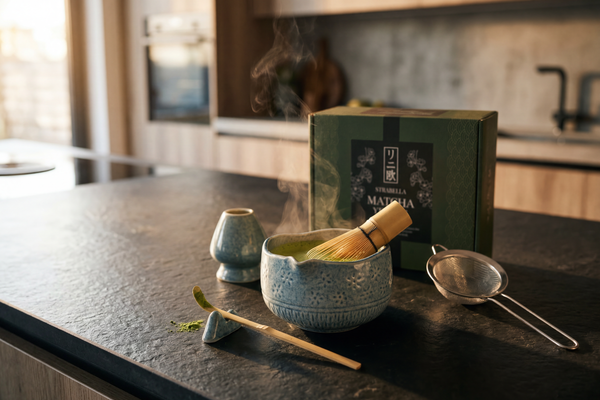
If you're new to matcha preparation, our Strabella Matcha Tea Set includes a 30g ceremonial grade tin, bamboo whisk (chasen), ceramic matcha bowl, and bamboo scoop with step-by-step preparation guide. This eliminates the guesswork and ensures you're preparing matcha correctly from day one.
Preparation Tips for Each Grade
Ceremonial Grade Preparation
Water temperature: 70-80°C (about 2 minutes off a rolling boil)
Powder amount: 2g (about 1 rounded bamboo scoop)
Water amount: 70-80ml for usucha (thin tea)
Whisking: 45 seconds with bamboo chasen in rapid "M" pattern until frothy
The key to ceremonial matcha is avoiding boiling water, which scalds the delicate amino acids and creates harsh bitterness even with premium powder. If you don't have a temperature-controlled kettle, pour boiling water into a room-temperature ceramic pitcher first — this drops the temperature into the ideal range.
Culinary Grade for Lattes
Create paste first: 2g matcha + 30ml hot water, whisk until smooth
Add milk slowly: Pour 180ml steamed milk gradually while stirring
Sweetener timing: Add maple syrup or honey to the paste before adding milk
Temperature: Serve at 65°C for optimal flavor balance
The paste method prevents lumps and ensures even matcha distribution throughout the latte. Many failed matcha lattes result from adding powder directly to hot milk, which creates clumps that won't dissolve.
Storage for Maximum Freshness
- Refrigerate after opening — matcha degrades rapidly at room temperature
- Keep airtight — oxygen exposure flattens flavor within weeks
- Use within 6 months — even properly stored matcha loses vibrancy
- Avoid freezing — temperature fluctuations create condensation damage
Leave a comment